Skip to content
FORMA

Documents

DECKS, BRIEFS & INDUSTRY REPORTS.

Everything we send to clients, in one place — free to download. Every number inside is sourced. New industry reports land here as we publish them.

6 Places AI Actually Pays Off — previewStart here

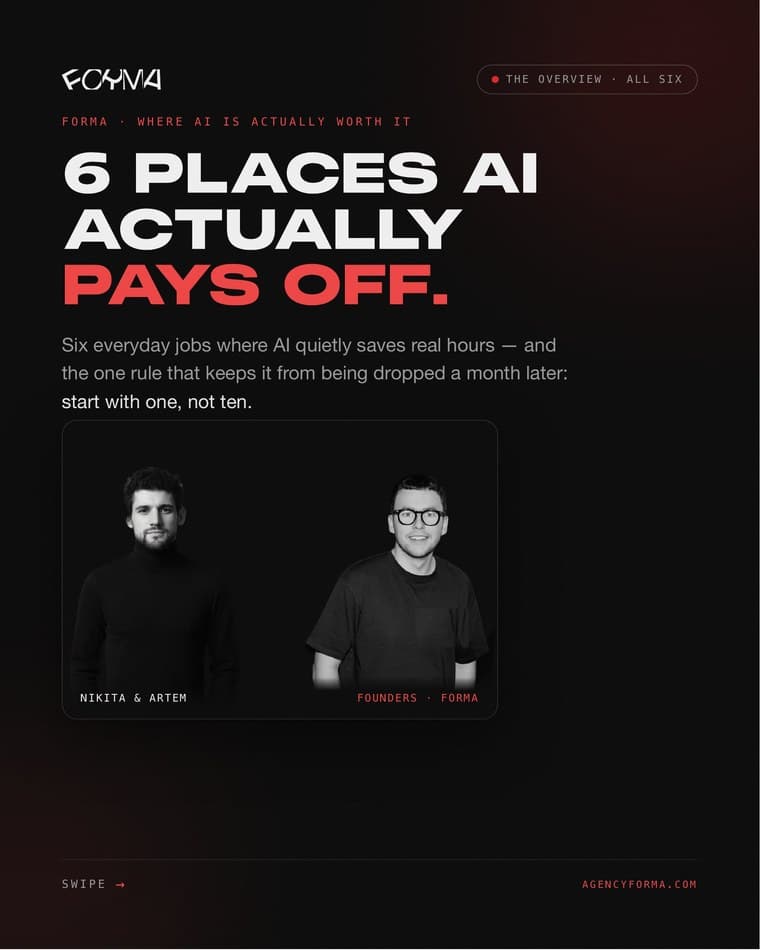
6 Places AI Actually Pays Off

The map before the detail — one navigator over all six everyday jobs where an AI agent earns its keep: customer support, asking your own documents, lead intake, contracts, inbox & scheduling, and the morning numbers brief. Each gets a plain one-liner and a single real proof number, then five simple steps that every one of them shares (it gets the request → checks your files → writes the answer → you check it → it sends and files it), and the line we never cross (it won't invent facts, won't send or sign on its own, runs on your servers). Built around one rule that keeps AI from being dropped a month later: start with one process, not ten. Dark deck, reality-only and sourced (S&P Global 2025; McKinsey 2012; HBR 2011; WorldCC + Deloitte 2023). Save it, send it to your partner, pick your first one.

Caption for Instagram

Most AI projects don't fail on the tech. They fail because someone tried to do ten things at once. 💾 Save this. 42% of companies dropped most of their AI last year — up from 17% the year before (S&P Global, 2025). The fix is boring and it works: pick one painful job, make AI great at it, then move on. Here are the six we get asked for most — and the everyday cost behind each: 01 · Customer support, 24/7 — answers the repeat questions instantly, hands the rest to a human. 74% of buyers expect always-on help (Zendesk, 2026). 02 · Ask your documents — a search box over your own files that answers in plain words, with the source. People lose ~1.8h a day just searching for info (McKinsey, 2012). 03 · Lead intake & qualifying — replies in seconds, asks the right questions, books the call. You're 7× likelier to qualify a lead if you reply within the hour (HBR, 2011). 04 · Documents & contracts — reads the long PDF and flags the risky lines before you sign. ~8.6% of a contract's value leaks from clauses nobody tracked (WorldCC + Deloitte, 2023). 05 · Inbox & scheduling — drafts the reply, proposes times, holds the slot — you just tap OK. ~28h a week goes to email, search and coordination (McKinsey, 2012). 06 · Reports & analytics — a short written brief on your numbers, waiting by 8am. All six are wired the same simple way: it gets the request → checks YOUR files (not the open internet) → writes the answer → you check anything that matters → it sends and files it. And the line we never cross: it won't invent facts, it won't send or sign on its own, and it runs on your servers — the code is yours. Pick the one job you repeat 3+ times a week, and book a 30-min mapping call. It's free — and on roughly 1 in 5 calls we'll tell you not to build it. → agencyforma.com Save this and send it to whoever you'd build it with. #ai #automation #b2b #operations #smallbusiness #aiagents #FORMA

9-slide carousel · 1080×1350 · PDF · 1.8 MB

Download PDF
Four Emails to Book One Thirty-Minute Call — previewCapability

Four Emails to Book One Thirty-Minute Call

An inbox and calendar that run themselves — without acting behind your back. The assistant sorts the mail, drafts the reply, offers times from your real calendar, and on one tap sends and books. Shown with a real request (client email → AI-drafted reply with three open slots, 'awaiting your OK'), the booked-and-confirmed card that follows one tap, the 4-step loop it runs, and a hard honesty slide (it won't send or book on its own, touch sensitive threads, double-book, or invent availability). Reality-only, sourced (McKinsey 2012; Calendly 2024 flagged as a vendor survey; Gloria Mark / UC Irvine; BMC 2016 on no-shows). A save-and-send sheet for anyone who lives in the inbox, not a pitch.

Caption for Instagram

It took four emails to schedule a thirty-minute call — and ninety seconds to actually hold it. 💾 Save this. The average knowledge worker spends about 28 hours a week reading email, searching for information, and coordinating with colleagues — leaving roughly 39% of the week for the actual job (McKinsey Global Institute, "The Social Economy," 2012). Scheduling is the quiet thief inside that: 43% of professionals lose 3+ hours a week just booking meetings (Calendly, State of Meetings 2024 — note: vendor survey), and it takes ~20 minutes to refocus after each interruption (Gloria Mark, UC Irvine). None of it is hard. It's just constant. So what does "handled" look like? A new client emails: "Loved the proposal — can we hop on a quick call this week?" The assistant drafts the reply and pulls three 30-min slots that are actually open on your side: — Thu 13 Jun · 15:00 · Fri 14 Jun · 11:30 · Mon 17 Jun · 09:00 …and waits. Nothing leaves the outbox until you tap Send. One tap, and it's done: reply sent, slot held, calendar invites to both sides, reminders set for 1 day and 1 hour before. Your effort: one tap. The 4 steps it runs, every time: an email arrives and gets sorted → it drafts a reply and offers times from your real calendar → you glance and tap OK → it sends, books, and sets reminders. What it will NEVER do: send or book on its own (every reply waits for your tap), touch personal or sensitive threads (it flags those to you), double-book or override your rules, or invent availability — if your calendar says you're full, it offers nothing. Even no-shows are real: clinics see ~18.8% (BMC Health Services Research, 2016) — which is exactly why the auto-reminders matter. Point it at the emails you keep re-typing, plus how your calendar works. In 48 hours we'll show it drafting replies and offering your real slots — you approve every one. No pitch. → agencyforma.com Save this and send it to whoever lives in the inbox. #productivity #scheduling #aiagents #b2b #operations #smallbusiness #FORMA

9-slide carousel · 1080×1350 · PDF · 4.7 MB

Download PDF
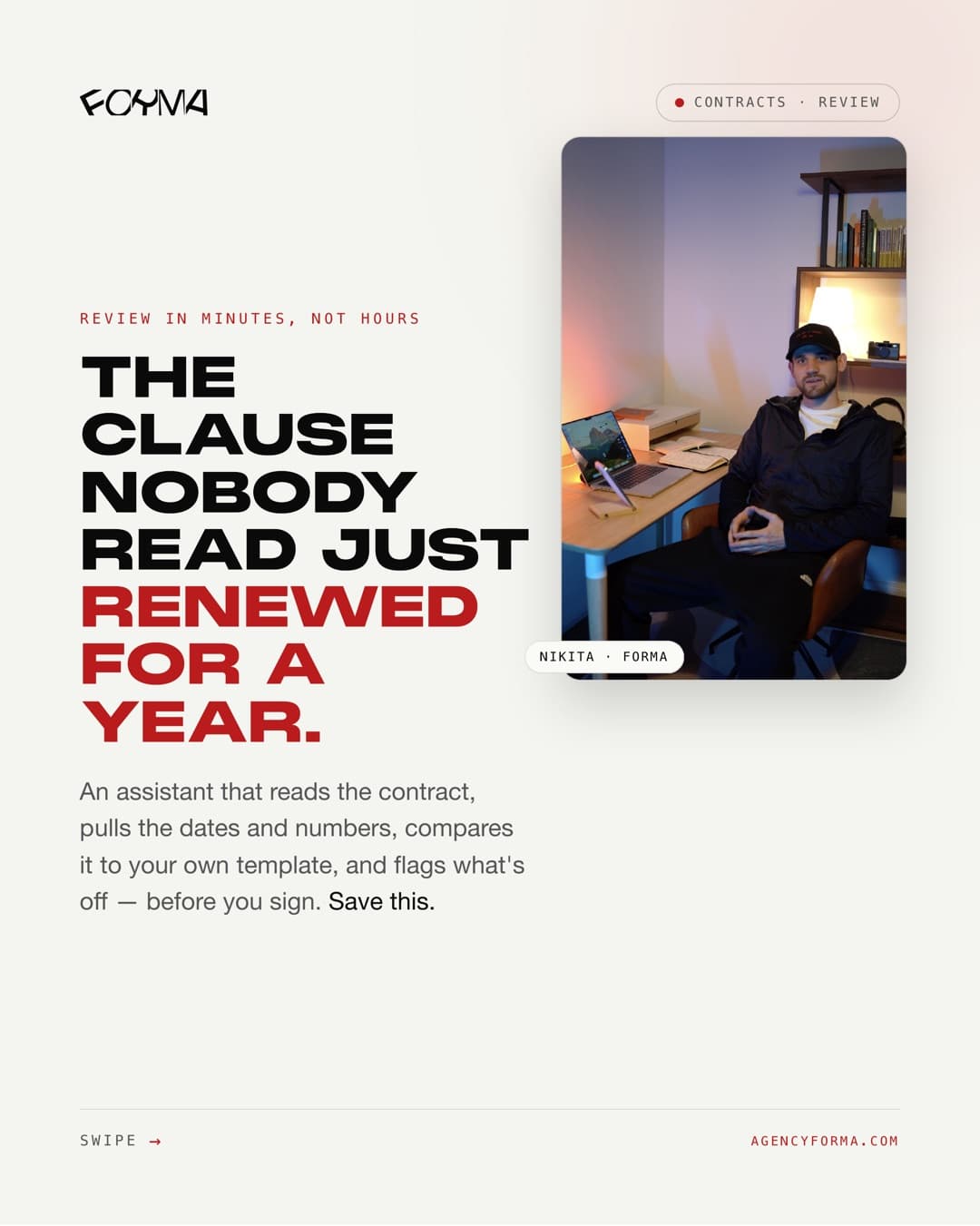
The Clause Nobody Read Just Renewed for a Year — previewCapability

The Clause Nobody Read Just Renewed for a Year

Contract review in minutes, not hours. An assistant reads an agreement, pulls the dates and amounts, compares every clause against your own template, and flags what's off — shown with a real flagged contract (auto-renewal, payment, liability), the one-page summary it produces, the 4-step path it follows, and a hard honesty slide (it won't replace your lawyer, give legal advice, decide, sign, or guess — a human always signs off). Reality-only, sourced (WorldCC + Deloitte 2023; the LawGeex 2018 study flagged as vendor-commissioned). A save-and-send sheet for anyone who reviews paperwork, not a pitch.

Caption for Instagram

The auto-renewal clause nobody had time to read just locked you in for another year. 💾 Save this. About 8.6% of a contract's value leaks away over its life — from missed obligations, auto-renewals on bad terms, and price changes nobody tracked (WorldCC + Deloitte, "ROI of Contracting Excellence," 2023, N=1,200+). Not fraud. Just clauses no one had time to read. So why don't we read every line? Time. Here's what a first-pass read can look like: in one controlled study, an AI flagged 94% of the risky clauses in 5 NDAs vs 85% for experienced corporate lawyers — and it read all five in 26 seconds while the 20 lawyers averaged 92 minutes (LawGeex study, 2018 — note: vendor-commissioned, and only NDAs; complex deals still need a human). For the boilerplate that fills the day, a first pass in seconds changes everything. What it actually does, on a real vendor agreement: ⚑ 4.2 Renewal — "renews automatically unless cancelled 90 days before expiry" → your template asks for 30. Diarise the cancel date. ⚑ 6.1 Payment — "due within 15 days, 2% monthly late fee" → Net-15, not your standard Net-30. That late fee is 24%/yr. ⚑ 11.3 Liability — "total liability not to exceed one month of fees" → well below your 12-month floor. What lands on your desk is one page, not forty: contract type, what auto-renews, payment terms, liability cap, the 3 clauses off your template, and "ready for your lawyer's sign-off." The 4 steps: you upload the contract → it reads & extracts the dates, sums and obligations → it compares every clause to your template → it flags what's off and writes the summary, for a human to decide. What it will NEVER do: replace your lawyer, give legal advice, decide or sign anything, or guess. If a clause is unusual, it routes it to a person — it doesn't invent a reading. It prepares the decision; a qualified human always makes it. Send us one contract you'd normally review, plus your standard terms. In 48 hours we'll send back the flagged summary — your template, your rules. A lawyer still signs. No pitch. → agencyforma.com Save this and send it to whoever reviews your contracts. #contracts #legaltech #procurement #aiagents #b2b #operations #FORMA

9-slide carousel · 1080×1350 · PDF · 1.6 MB

Download PDF
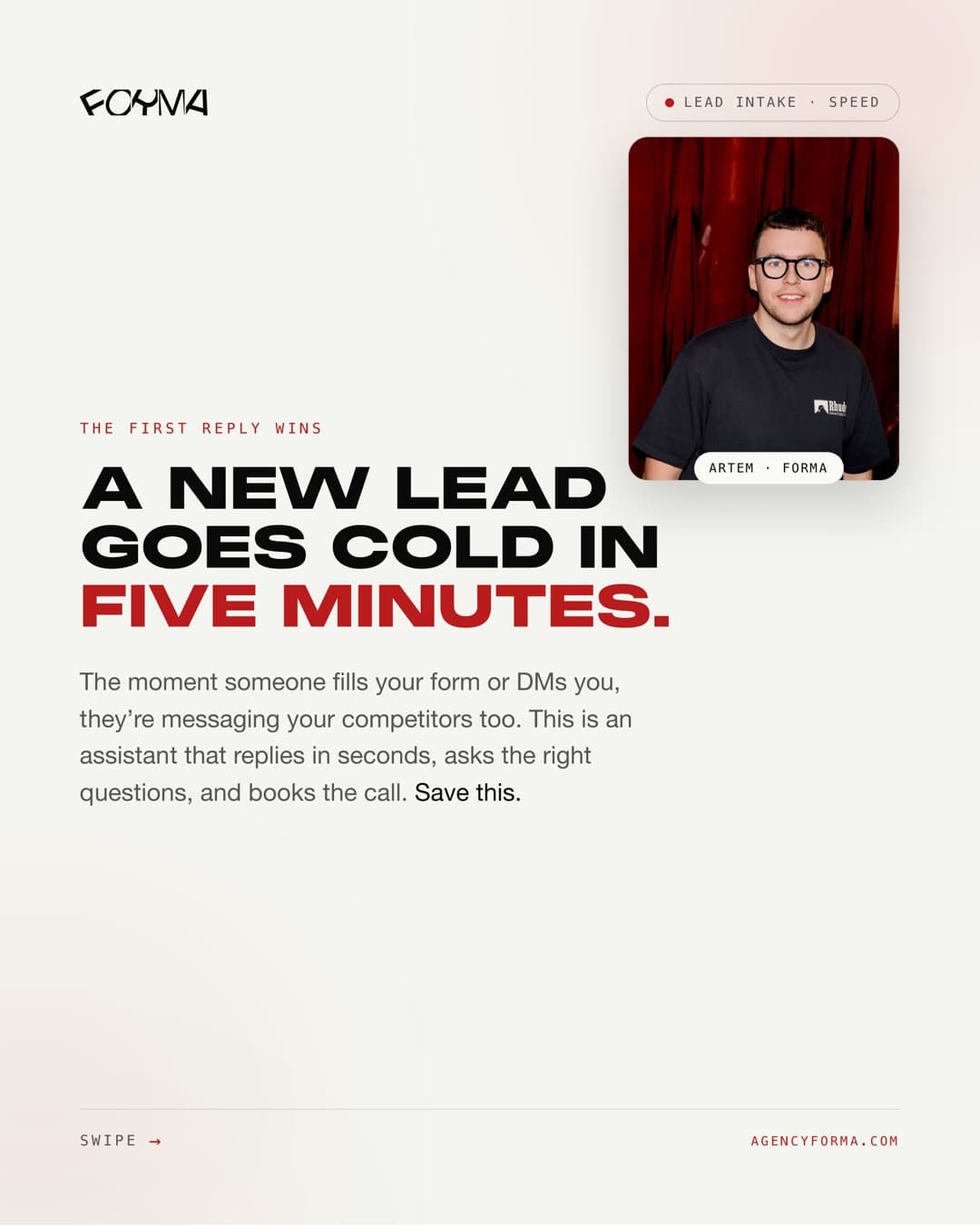
A New Lead Goes Cold in Five Minutes — previewCapability

A New Lead Goes Cold in Five Minutes

Most enquiries land in the evening — and the average online lead then waits ~42 hours for a first reply (InsideSales / Lead Response study). This is how an assistant replies in seconds, asks your 2–3 qualifying questions, books the call and writes a clean lead to your CRM — shown with a real qualification chat, the resulting lead card, the 4-step path it follows, and what it will never do (it won't spam, fake being human, book outside your rules, or guess). A save-and-send sheet for anyone who chases inbound leads, not a pitch.

Caption for Instagram

A new lead fills your form at 9pm. By the time you reply Monday, they've booked with someone who answered Friday night. 💾 Save this. The average online lead waits ~42 hours for a first reply (InsideSales / Lead Response study) — and that wait is where deals leak. Why minutes matter, in published research (not our promise): • You're 7× more likely to qualify a lead if you reply within the first hour (Harvard Business Review, 2011). • And 21× more likely if you reply in 5 minutes vs 30 (MIT / InsideSales). Whoever answers first owns the conversation. So what does "answered in seconds" actually look like? A real estate enquiry at 9:14pm: — "Is the 2-bed marina apartment still available?" — (in 6s) "It is! To send you the right options — what's your budget, and is this to live in or invest?" — "~$1M, to live in. Moving in about 2 months." — "Perfect, I have 3 that fit. Book a 15-min viewing: Tue 10:00 or Wed 16:00?" By morning that's not a mystery DM — it's a clean lead in your CRM: looking for a 2-bed marina view, ~$1M to live in, moving in ~2 months, reachable on WhatsApp, scored Qualified · hot, viewing booked Tue 10:00. The 4 steps it runs, every time: lead arrives (any channel, any hour) → replies in seconds → asks your 2–3 questions → books the call & logs it, or hands a tricky one to a human. What it will never do: spam or chase, pretend to be human, book outside your rules, or guess — asked something off-script, it flags a person instead of inventing an answer. Send us one real enquiry you'd normally get. In 48 hours we'll show you the assistant replying, qualifying and booking it — on your questions, your calendar. No pitch. → agencyforma.com Save this and send it to whoever chases your leads. #leadgeneration #aiagents #realestate #b2b #sales #automation #FORMA

9-slide carousel · 1080×1350 · PDF · 3.1 MB

Download PDF
Your AI Rollout, Mapped — previewRoadmap

Your AI Rollout, Mapped

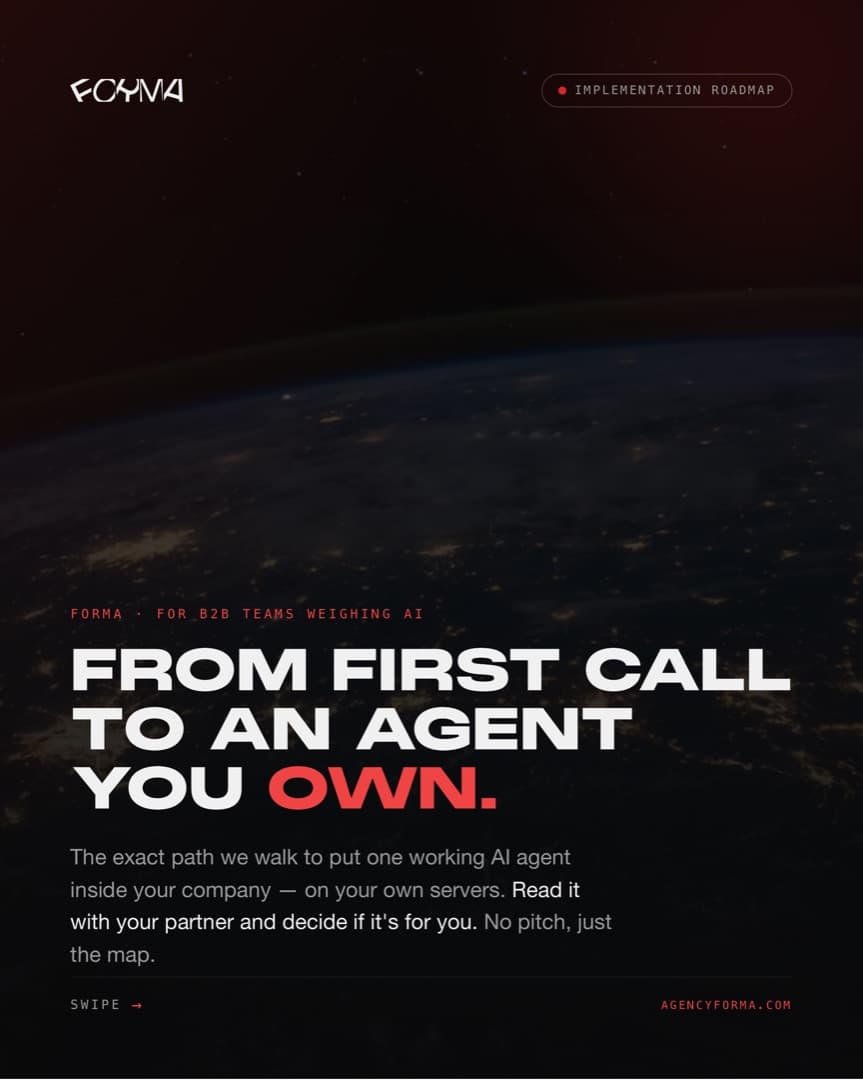
The exact path we walk to put one working AI agent inside your company — on your own servers. Five phases from a free mapping session to code you own, a node-by-node schema of how a single agent is wired, and three questions to decide with your partner before you start. 42% of companies scrapped most of their AI last year (S&P Global, 2025) — almost always for the lack of a plan. This is the plan. Read it with your partner, no pitch.

Caption for Instagram

Thinking about putting AI inside your company but not sure what actually happens after you say yes? Here's the whole roadmap — read it with your partner and decide if it's for you. 💾 Save this. 42% of companies scrapped most of their AI last year, up from 17% (S&P Global, 2025). The tech rarely fails — the plan does. So here's ours, top to bottom: Phase 00 — MAP (week 0, free): a working session on the process eating your time. You leave with a written map, yours to keep even if we never work together. Phase 01 — PILOT (14 days): one working agent goes live on YOUR servers — real work, not a demo. The code is yours from day one. Phase 02 — PROVE (weeks 2–4): we measure it against a clear "done right" before anyone leans on it. If a slip would reach a client, a human stays in the loop. Phase 03 — ROLL OUT (weeks 4–8): we stay until your team actually uses it. Adoption, not launch, is the hard part. Phase 04 — OWN: code, hosting and running costs on the table up front, running on your infrastructure. Not paid back in 60 days? Full refund. Inside, you also get the schema of how one agent is wired — Intake → Retrieve (RAG, from your documents) → Reason → Draft → Human check → Deliver — and three questions to answer together before you start. Want this mapped for your real business? Book a 30-min call — on ~1 in 5 we tell you not to build it. → agencyforma.com Save this and send it to whoever decides on AI with you. #aiagents #aiadoption #b2b #automation #digitaltransformation #founders #FORMA

9-slide carousel · 1080×1350 · PDF · 1.8 MB

Download PDF
Where AI Pays — and Where to Leave It Alone — previewSelf-audit

Where AI Pays — and Where to Leave It Alone

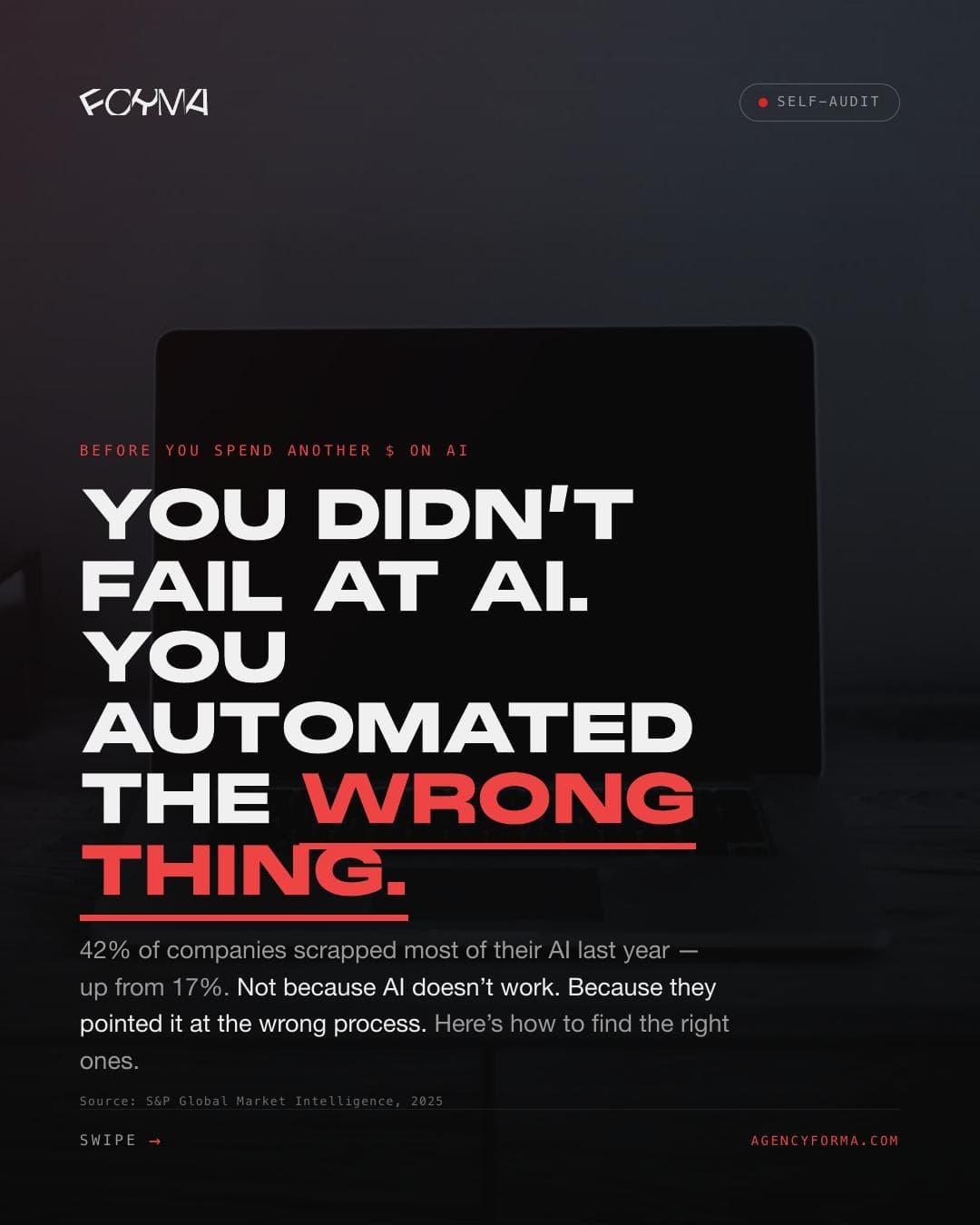
A 3-question test to score every process in your business: should AI run it, or should you leave it human? 42% of companies scrapped most of their AI last year — not because AI failed, but because they automated the wrong thing. The checklist that finds the right ones.

Caption for Instagram

"I tried AI, it didn't stick." "Bought the tool, never used it." "Not sure what's actually worth automating." If that's you — the problem usually isn't AI. It's that it got pointed at the wrong process. 💾 Save this audit. 42% of companies scrapped most of their AI last year, up from 17% (S&P Global, 2025). Not because AI doesn't work — because they automated the wrong thing. Here's the test. Run every process in your business through 3 questions: 1. Does it repeat at least 3× a week? (Rare tasks cost more to build than they save.) 2. Is there a clear "done right" you can measure? (No measure → no way to trust the output.) 3. If AI slips, do you catch it before a client does? (If your customer notices first, keep a human in the loop.) Three yes = hand it to AI. Any no = keep it human, or fix the process first. And never automate a process that's already broken — "automating a mess yields an automated mess." (Michael Hammer, HBR) ✅ Grow with AI: lead intake & first replies · first-draft emails, docs & summaries · booking, reminders & follow-up · order status & FAQ 24/7 · qualifying leads · assembling reports from data. – Don't bother: who to hire or let go · what your brand stands for · closing & negotiating deals · rare or one-off tasks · anything with no clean data · a process that's still broken. We build AI agents for a living — and we'd rather you point them at the right processes. Want this scored for your real business? We map it free, and on ~1 in 5 calls we tell you not to build it. → agencyforma.com Save this and send it to whoever's deciding where AI fits in your business. #aiautomation #smallbusiness #aiagents #b2b #operations #founders #FORMA

3-slide carousel · 1080×1350 · PDF · 0.8 MB

Download PDF
When to Trust AI — and When Never — previewPlaybook

When to Trust AI — and When Never

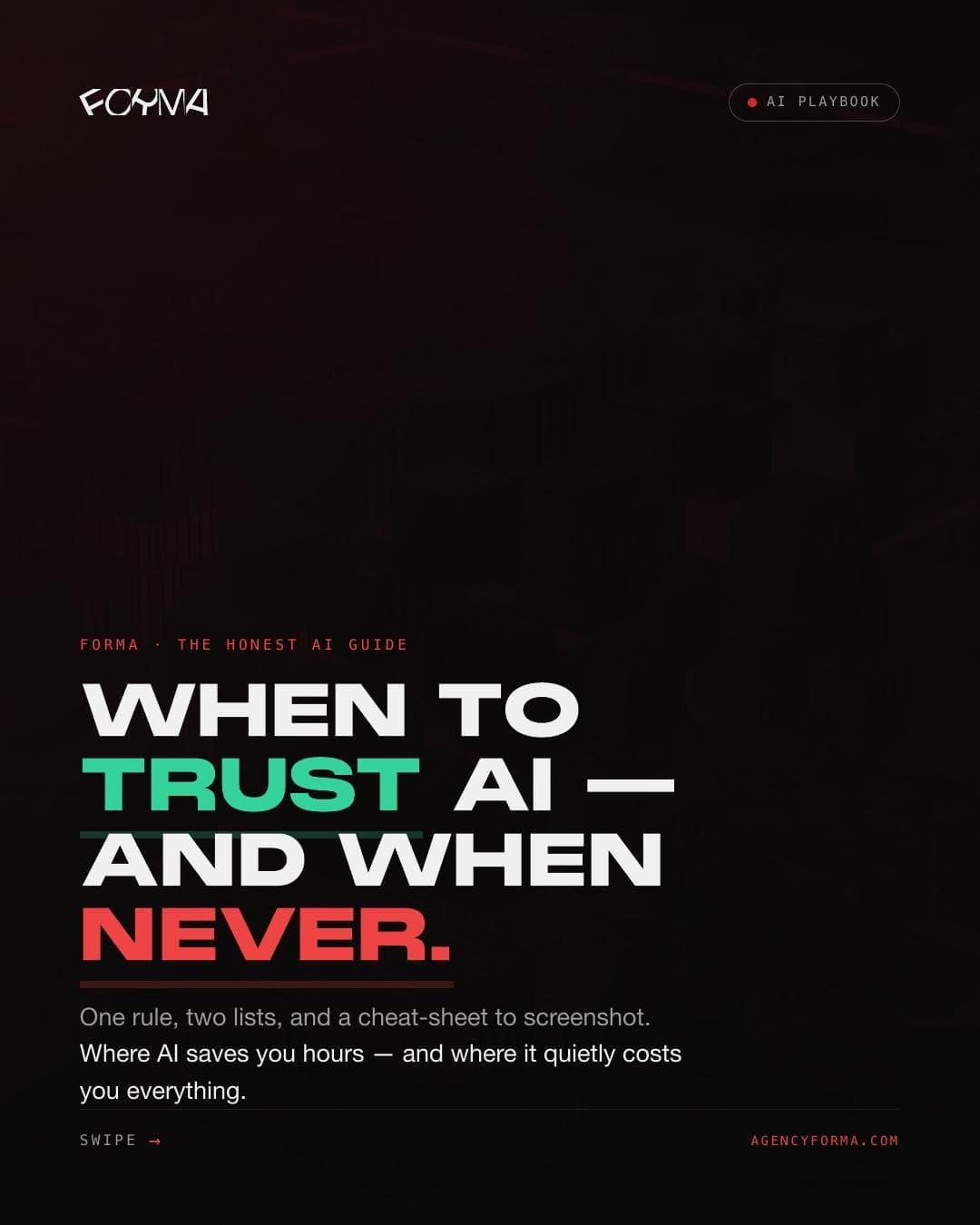
One rule, two lists, and a cheat-sheet to screenshot. Where AI saves you hours (logic, volume, memory) and where it quietly costs you everything (people, values, the final call). The honest line we build our agents to — save it and send it.

Caption for Instagram

Most people get one thing wrong about AI: they trust it with the decisions, and do the busywork themselves. It should be the other way around. 💾 Save this. The whole rule fits in one line: Runs on LOGIC? Trust it. Runs on JUDGEMENT? Don't. ✅ Trust AI with — the green list: • Replying to 500 leads a day, instantly, 24/7 • Writing the first draft of emails, replies & summaries • Qualifying leads before they reach your sales team • Scheduling & rescheduling every meeting • Following up for 60 days straight without forgetting one • Finding the pattern in piles of business data → Anything that runs on logic, volume or memory. Boring, repeatable, checkable — let it run. ⛔ Never trust AI with — the red list: • Deciding who to hire, or who to let go • Deciding what your brand stands for • Choosing which clients to walk away from • Reading the room in a live negotiation • Knowing when to stop pushing a deal • Deciding what the data means for your business → Anything that runs on intuition or carries human weight. AI can inform it — it can't own it. We build AI agents for a living, and this is the line we build to: an agent that only ever touches the green column. → agencyforma.com Save this and send it to whoever's deciding what to hand off to AI. #aiagents #automation #b2b #aistrategy #rag #founders #FORMA

5-slide carousel · 1080×1350 · PDF · 0.7 MB

Download PDF
FORMA — Who We Are — previewAbout

FORMA — Who We Are

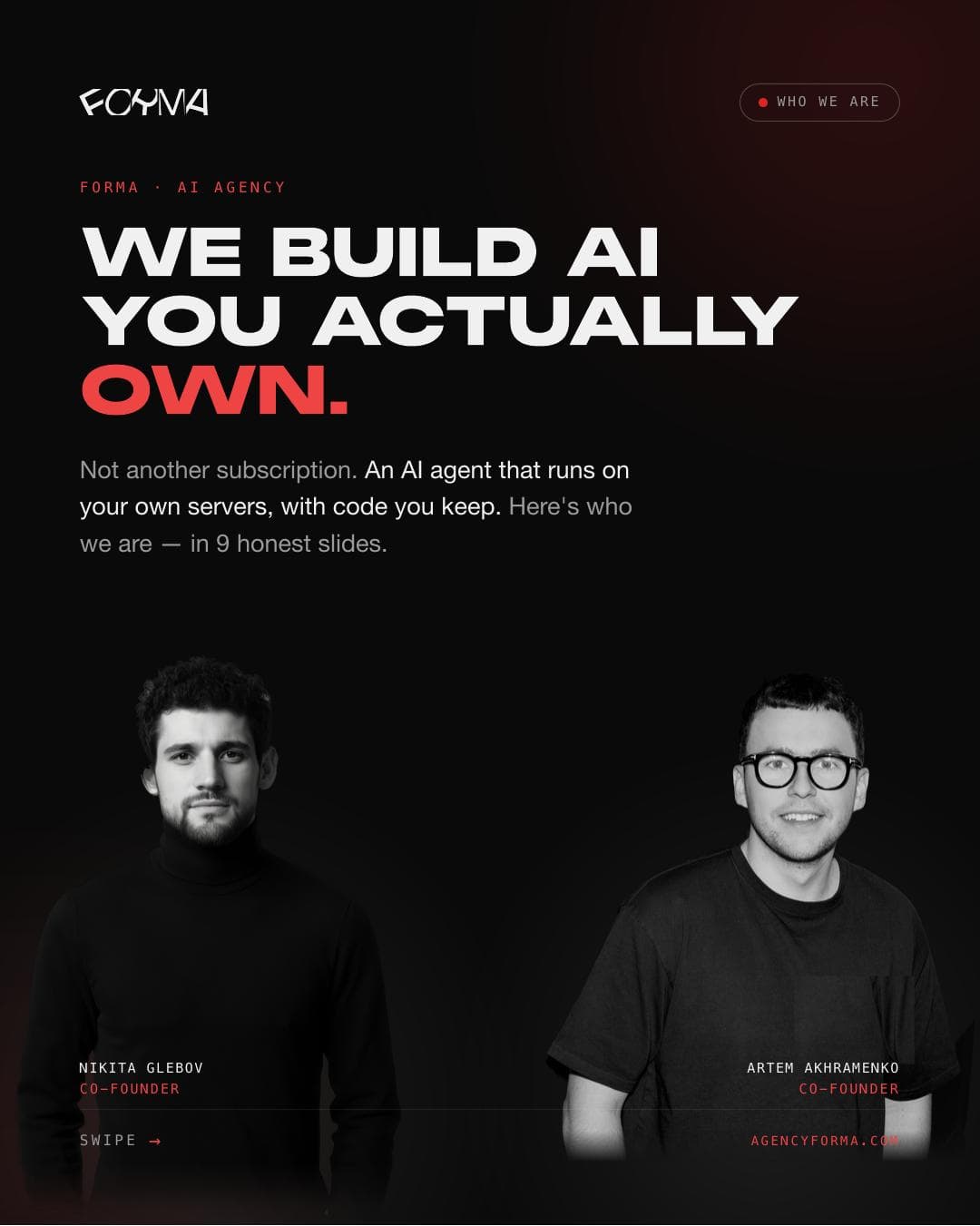
Who we are and how we work, in plain language: we build AI agents + RAG that run on your own servers, with code you keep. The honest version — what AI is good for, what we won't promise, and a refundable 14-day pilot. Save-and-send, not a sales deck.

Caption for Instagram

Most AI agencies sell you a demo. We'd rather show you the honest version. We build two things, well: AI agents (software that does a whole task end to end — searches, reads, drafts, delivers, like a tireless assistant) and RAG (answers pulled from YOUR documents, not the public internet — so they're grounded, not guessed). What makes us different: • It runs on your own servers, and the code is yours to keep — not one more subscription you rent forever. • We map where it actually pays before we build — and you keep that map even if we never work together. • We stay through rollout until your team actually uses it. Launch is the easy part. • A refundable 14-day pilot: one working agent live in your systems, or your money back. What we won't do: promise magic, invent case studies, or use logos that aren't ours. We're a young studio and we'd rather earn trust with real, sourced work than borrowed credibility. Want to see where AI would earn its keep in your business? Book a free working session — you leave with a written map, no pitch. → agencyforma.com Save this and send it to whoever's weighing AI for your team. #aiagents #rag #automation #b2b #aiconsulting #founders #FORMA

10-slide carousel · 1080×1350 · PDF · 2.0 MB

Download PDF
10 AI Tools That Replace Your Assistant — previewToolkit

10 AI Tools That Replace Your Assistant

The free-first stack across comms, ops, content and research — with real 2026 pricing from each tool's official page. 9 of 10 have a genuine free tier. A cheat-sheet you save and send your team, not an affiliate dump.

Caption for Instagram

10 AI tools that quietly replace half an assistant's workload — and 9 of them have a real free tier. 💾 Save this one. We sell AI agents for a living, but these are the off-the-shelf tools we'd hand a friend drowning in admin. No affiliate links. No kickbacks. Just the honest stack across comms, ops, content and research — with real pricing pulled from each tool's official page in June 2026. Inside: • Comms — ChatGPT, Superhuman, Otter.ai • Ops — Notion AI, Make.com, Cal.com • Content — Descript, Opus Clip • Research — Perplexity, Fathom • A one-screen cheat-sheet to screenshot One honest note: prices shift, so check before you buy — and Superhuman is the only one here without a free tier. These tools rent you AI. When you outgrow them and want an agent trained on your data, running on your servers — that's what we build. → agencyforma.com Save this and send it to your team. #aitools #productivitytools #aiagents #automation #founders #FORMA

9-slide carousel · 1080×1350 · PDF · 1.3 MB

Download PDF
Dubai Real Estate — Lead Leak Playbook — previewIndustry

Dubai Real Estate — Lead Leak Playbook

The 5 ways Dubai brokers lose inbound leads — and the exact fix for each, plus the no-code starter stack (WhatsApp, ChatGPT, DeepL, Cal.com, HubSpot) you can plug in today. Backed by DLD market numbers and speed-to-lead research (HBR, MIT). A save-and-forward playbook, not a pitch.

Caption for Instagram

Speed-to-lead is the entire game in Dubai property right now. The market closed AED 761B and 226,000 deals in 2024 (Dubai Land Department). Demand isn't the problem — response is. A buyer messages five agencies at 11pm, and whoever replies first wins the conversation. Here are the 5 ways brokers quietly leak those leads — and the exact fix for each: 1. A 15-hour first reply → answer in seconds, 24/7 2. After-hours enquiries cool overnight → round-the-clock coverage 3. Only 2-3 languages on the team → reply natively in 5+ 4. An hour matching units by hand → a cited shortlist in seconds 5. Guessed answers on Golden Visa / Ejari / Oqood → grounded, with the source The numbers behind this are published research, not our promise — reply within 1 hour and you're 7× more likely to qualify the lead (Harvard Business Review). When you want it running as an AI agent on your own servers, the link's below. → agencyforma.com Save this for the next time an inbound goes cold — and send it to whoever runs lead response on your team. #dubairealestate #realestate #aiagents #speedtolead #propertydubai #automation #FORMA

11-slide carousel · 1080×1350 · PDF · 1.6 MB

Download PDF
Recruitment Agencies — 4 Ways You Leak Placements — previewIndustry

Recruitment Agencies — 4 Ways You Leak Placements

The 4 quiet leaks that cost agencies fills — re-sourcing your own base, 8-hour manual screens, ghosted candidates, missed redeployments — and the RAG-agent fix for each. Backed by Gem 2025, SHRM and Greenhouse data (Bullhorn figures flagged as vendor data). A save-and-send cheat sheet for your desk, not a pitch.

Caption for Instagram

You source the same candidate twice — and never notice. 44% of sourced hires in 2024 were already sitting in your own CRM (Gem, 2025 Recruiting Benchmarks). Half your sourcing, done a second time, because nobody can instantly see who you already know. That's one of 4 quiet leaks that cost agencies placements — and the fix for each: 1. Re-sourcing your own database → a cited shortlist from your CRM in seconds 2. 200 CVs screened by hand while the client picks someone else → an AI shortlist the same day 3. 65% of candidates never hear back on status (Lever) → automatic, human-sounding updates 4. A contractor rolls off and nobody calls → redeployment flagged before the gap The fix isn't another job board. It's an agent that reads your own ATS and answers "who fits this req?" with the candidate and the source — so a req in becomes a shortlist out. Numbers here are published research (Gem, Lever, SHRM); ATS-vendor figures are flagged as such inside. Not our promise — the proof you can check. → agencyforma.com Save this and send it to whoever runs your desk. #recruitment #staffing #talentacquisition #aiagents #ATS #automation #FORMA

9-slide carousel · 1080×1350 · PDF · 1.5 MB

Download PDF
E-commerce — Where Your Store Leaks Money — previewIndustry

E-commerce — Where Your Store Leaks Money

The 4 quiet ways online stores lose sales every day — the endless "where's my order?", the 11pm shopper nobody answered, the 7-in-10 carts that die, and the return that turns into three tickets — with the fix for each. Backed by Baymard, NRF and Klaviyo data (helpdesk-vendor figures flagged). A save-and-send cheat sheet, not a pitch.

Caption for Instagram

Most stores don't lose the sale at checkout. They lose it everywhere else. 7 in 10 carts are abandoned (Baymard, 70.2% avg, Sept 2025) and nearly 1 in 5 orders comes back as a return (NRF + Happy Returns, 19.3%, 2025). The leaks are quiet, daily, and mostly about answers nobody gave in time. The 4 places your store leaks money — and the fix for each: 1. "Where's my order?" all day, forever → instant answers from your own order data 2. The 11pm shopper with one question and no reply → a quarter of orders land in the evening when most stores are offline (ECDB 2024) → 24/7 answers 3. Full cart, then they vanish → 39% abandon over surprise costs (Baymard 2025) → a recovery flow that fires in minutes 4. One return that turns into three messages → 82% say easy returns decide whether they buy again (NRF + Happy Returns 2025) → guided, self-serve returns It answers only from YOUR data — FAQ, prices, policies, order status — and hands off to a human when unsure. It never guesses. Published research above (Baymard, NRF, ECDB, Klaviyo); helpdesk-vendor figures flagged inside. → agencyforma.com Save this and send it to whoever runs your store. #ecommerce #shopify #customerexperience #aiagents #cartabandonment #automation #FORMA

10-slide carousel · 1080×1350 · PDF · 1.6 MB

Download PDF
The 8am Brief — Your Numbers, Read For You — previewLeadership

The 8am Brief — Your Numbers, Read For You

A plain-language summary of how the business did yesterday — in your inbox before coffee, no dashboard diving, no waiting on an analyst. How an agent pulls your own numbers, compares them, writes a 30-second brief and delivers it on schedule — what it does and what it won't (it never invents a figure). A save-and-send cheat sheet for founders and ops, not a pitch.

Caption for Instagram

Every morning you open five tabs to answer one question: how did we do yesterday? Revenue lives in your store. Ad spend in another tool. Cash in a spreadsheet. By the time someone stitches it together, the day's decisions are already made on a hunch. Here's the alternative — one plain-language brief, in your inbox by 08:00, before you open a single tab. An agent pulls your own numbers, compares them to yesterday and last week, writes a 30-second summary a human actually reads, and delivers it on a schedule you pick (email, Slack or Telegram). No dashboard diving. No waiting on an analyst. What it won't do: it never invents a number. Every figure comes from your own sources — if a source is missing, it says so instead of guessing. It hands you a clear picture; the decision stays yours. And it runs on your own setup — a system you keep, not one more subscription. Tell us the 3 numbers you check most and where they live. In 48 hours we'll send back a real sample morning brief, built from your sources. No pitch. → agencyforma.com Save this and send it to whoever starts their morning in a spreadsheet. #aiagents #businessintelligence #founders #ecommerce #analytics #automation #FORMA

7-slide carousel · 1080×1350 · PDF · 3.5 MB

Download PDF
Ask Your Documents a Question — previewCapability

Ask Your Documents a Question

Your team already has the answer — it's just buried in a file somewhere. This is an assistant that reads only YOUR documents (PDFs, policies, price lists, contracts) and answers a plain question with the exact file and page, so you can check it in a click. Includes a real sourced-answer example, the 4-step path, and what it will never do (it won't invent answers, won't pull from the internet, won't leak your files). The plain-language version of "RAG." A save-and-send cheat sheet for any team that drowns in documents, not a pitch.

Caption for Instagram

Your team already has the answer. It's just buried in a file. The average knowledge worker spends about 1.8 hours a day just searching for and gathering information (McKinsey Global Institute) — that's entire workdays a week, per person, lost to "which folder was that in?" "Can't I just ask ChatGPT?" — for the world's knowledge, sure. But a general chatbot has never seen your prices, contracts or policies, so for your business it guesses. This is the opposite: an assistant that reads ONLY the documents you give it, and shows the exact file and page behind every answer — so you can verify it in one click. (The technical name for this is "RAG." All it means: answer from your files, then cite the source.) How it works: you ask in plain words → it searches only your connected files → finds the exact passage → answers and links the source. Where it earns its keep: sales teams ("does our plan cover X?" mid-call), HR & ops ("how many vacation days carry over?"), support & field staff ("what's the fix for error 27?"), finance & legal ("what's the notice period in this contract?"). What it will never do: make things up, pull from the internet, leak your files, or replace your experts — it runs on your own setup, behind your own access rules. Send us a handful of your documents and 5 questions you ask them. In 48 hours we'll send back a working assistant that answers — with the source. No pitch. → agencyforma.com Save this and send it to whoever drowns in your docs. #knowledgebase #rag #aiagents #operations #smallbusiness #automation #productivity #FORMA

8-slide carousel · 1080×1350 · PDF · 4.8 MB

Download PDF
Customer Support That Never Sleeps — previewCapability

Customer Support That Never Sleeps

A lot of customers reach out after you've closed — and 74% now expect an answer at any hour (Zendesk CX Trends 2026). This is how an assistant answers them instantly using only your own data — FAQ, prices, policies, order status — with a real sample chat, the 4-step path it follows, and what it will never do (it never invents an answer; it hands off to a human when unsure). Backed by Gartner and Qualtrics 2024 data. A save-and-send cheat sheet for anyone who answers customer DMs, not a pitch.

Caption for Instagram

A question lands at 11pm. Who answers it? 74% of customers now expect support at any hour — because instant replies have become the norm everywhere else (Zendesk CX Trends 2026). Miss the evening and weekend window and you're not just closed — you're handing those buyers to whoever replied first. "But won't a chatbot just annoy them?" — yes, if it's a generic one. Plain self-service tools fully resolve only 14% of issues on their own (Gartner, 2024). The difference is an assistant that reads YOUR real info: FAQ, prices, policies, order status — so it answers the actual question, instantly, any hour, in the customer's own language. And when it isn't sure, it hands the whole thread to a human. It never guesses. 73% of buyers are perfectly fine with a bot — as long as it knows the answer (Qualtrics, 2024). Where it earns its keep: online stores ("where's my order?" at 11pm), local services (hours, pricing), clinics & salons (bookings, reschedules), SaaS (setup, how-to). What it will never do: invent an answer, pretend to be human, replace your team, or become one more subscription — it runs on your own setup, a system you own. Send us your 5 most-asked questions and your FAQ. In 48 hours we'll send back a working assistant that answers them from your info. No pitch. → agencyforma.com Save this and send it to whoever answers your DMs. #customersupport #ecommerce #aiagents #smallbusiness #automation #customerexperience #FORMA

8-slide carousel · 1080×1350 · PDF · 1.3 MB

Download PDF

Want a report for your industry? Tell us your niche on a discovery call and we'll build one — with real, sourced numbers, never invented case studies.